Representing a surface
- Explicit:
- Implicit:
- Parametric: , ,
| Surface | Parametrization |
|---|---|
| Cone | |
| Sphere | , , |
| Cylinder | |
| Paraboloid |
Smooth surface: continuous and .
Parametrized surfaces
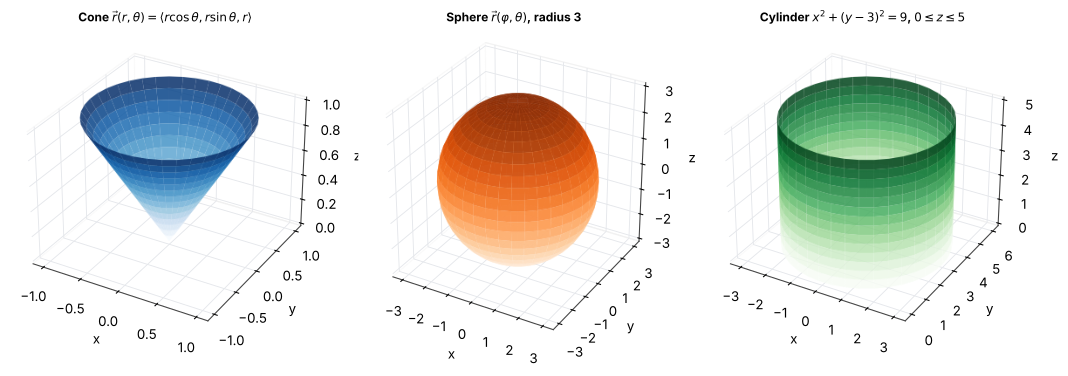
Cone, sphere and cylinder from the table above, drawn from their parametrizations.
Surface area element
| Form | |
|---|---|
| Parametric | |
| Implicit | , = unit normal to the shadow plane ( for the -plane, ) |
| Explicit |
Surface area: .
- Sphere of radius : ⇒ area .
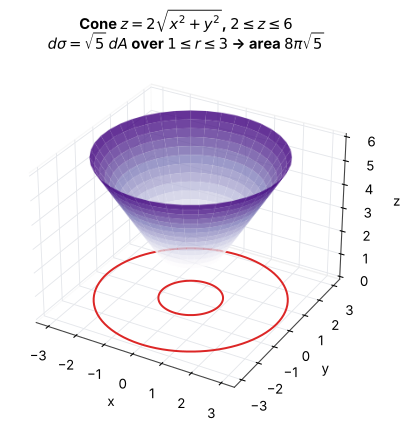
Area of a cone band
between and : ⇒ over the ring .
Area .
Surface integral of a scalar function
For a closed piecewise surface (e.g. a cube), add the integrals over each face.
Flux of a 3D vector field
Unit normal :
- Plane :
- Level surface :
- Parametric: , so
Choose the sign of to match the required orientation (outward, “away from the -axis”, …).
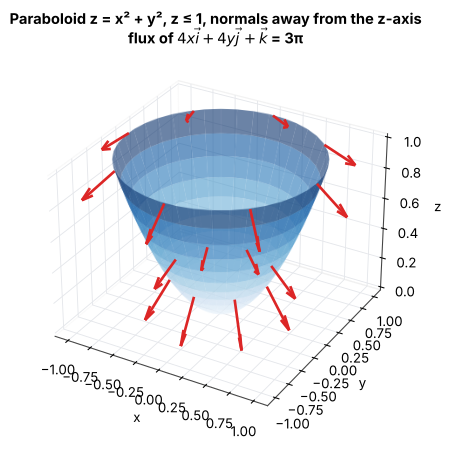
Flux through a paraboloid
through , , normal away from the -axis.
, and the outward normal is .
.
Curl
Stokes’ Theorem
piecewise smooth oriented surface with boundary curve (counterclockwise with respect to ):
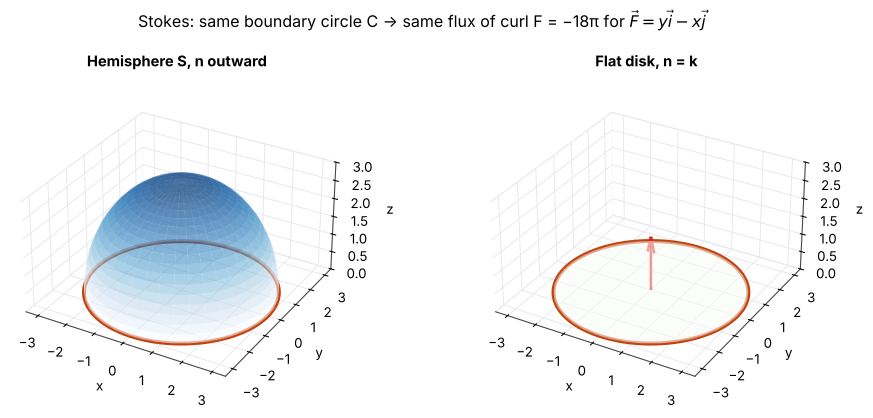
Circulation of around = flux of through . Any surface with the same boundary gives the same value (e.g. replace a hemisphere by the flat disk, , ).
Hemisphere vs disk
, . Boundary : .
; flux of the curl through the hemisphere ; through the flat disk (): .
Divergence Theorem
For a piecewise smooth closed oriented surface enclosing (outward normal):
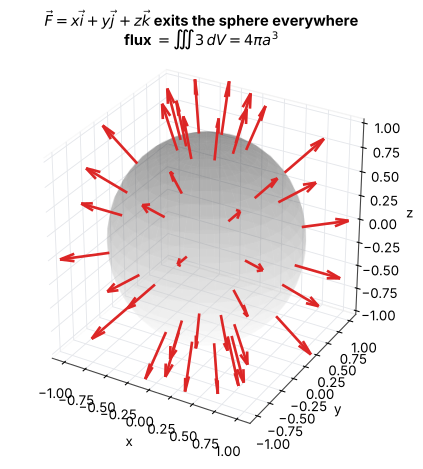
Outward flux = divergence integral. Example: on the sphere of radius : both sides equal .
Expanding field through a sphere
on : ⇒ flux .
⇒ . Both equal .