Part 1 — Functions, Domain, Range, Level Curves, Limits, Continuity
Functions of two variables
, .
- = domain, set of -values = range; independent (inputs), dependent (output).
- Typical domain constraints: → radicand ; → argument ; denominator .
Regions in the plane
- Interior point: center of some disk lying entirely in .
- Boundary point: every disk around it contains points inside and outside .
- Open: all points are interior. Closed: contains all its boundary points.
- Bounded: lies inside some disk of fixed radius; otherwise unbounded.
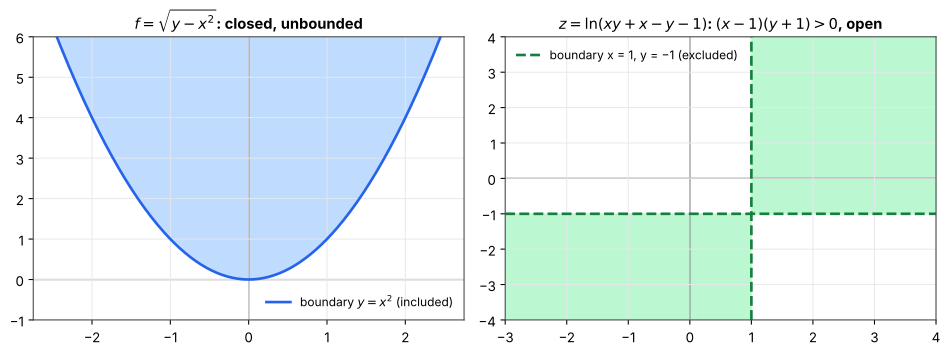
Domains
- : , closed (contains the parabola) and unbounded.
- : , i.e. ; open, boundary and .
Graphs and level curves
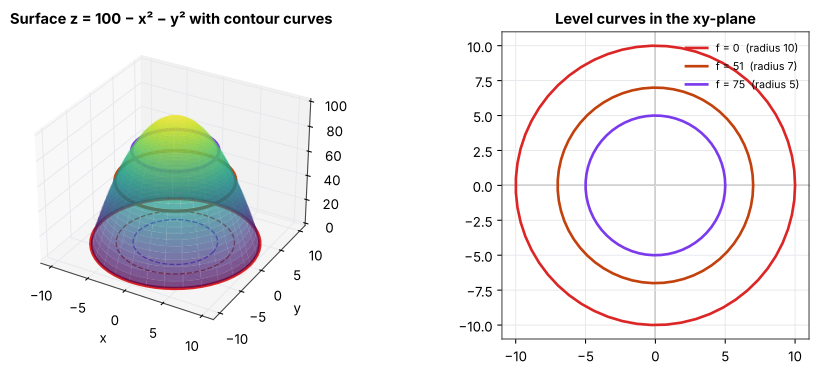
- Level curve: set of points in where (drawn in the -plane).
- Graph / surface: all points in space.
- Contour curve: the curve in space where the plane cuts the surface (the level curve lifted to height ).
Paraboloid
Level curves are circles of radius . The contour curve is the circle lifted to height 75.
Limits
- may approach from any direction.
- Limit rules: sum, difference, constant multiple, product, quotient (), power, root ( for even roots).
- Polynomials/rational functions (defined at the point): just substitute.
- Indeterminate with roots: multiply by the conjugate.
Uniqueness: a limit, when it exists, is the same along every path.
Two-path test: if has different limits along two paths to , the limit does not exist (typical paths: , , , ).
Polar coordinates (at the origin): , , for all .
- If the result is independent of → the limit exists.
- If it depends on → the limit does not exist.
- At : , .
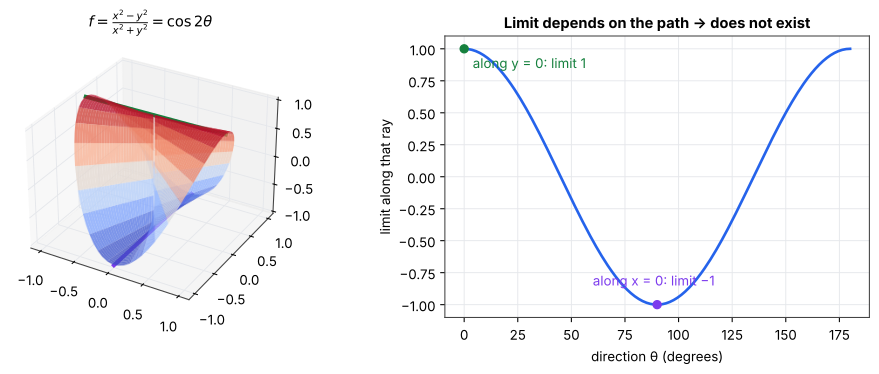
Two paths, two limits
: along the limit is ; along it is . In polar form depends on ⇒ no limit at .
Continuity
is continuous at if
- is defined,
- exists,
- the limit equals .
Useful tool: sandwich theorem, e.g. .
Part 2 — Partial Derivatives, Chain Rule, Implicit Differentiation
Partial derivatives
- To compute : treat (and other variables) as constants; same idea for , .
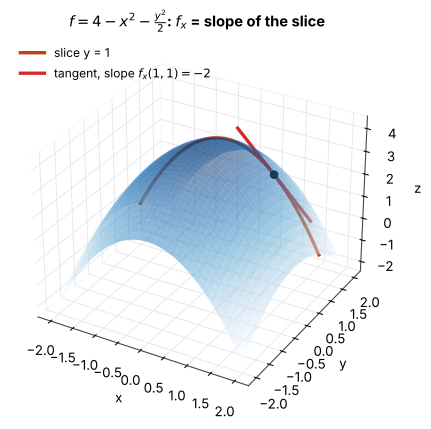
- Geometrically: is the slope of the curve cut on the surface by the plane .
Second-order: , , , .
Schwarz (Clairaut) theorem: if are continuous on an open region around , then .
Slope of a slice
: , so = slope of the curve cut by the plane at .
Differentiability
is differentiable at if exist there and
(i.e. with ). Partials existing alone is not enough.
Chain rule
- One variable: .
- , , :
- : add .
- Functions on surfaces: with functions of :
- Use a dependency (tree) diagram: multiply along each branch, add the branches.
Implicit differentiation
If defines as a differentiable function of and :
Part 3 — Directional Derivative, Gradient, Tangent Lines/Planes, Differentials
Vector review
- , ; is a unit vector.
- Dot product: ; .
- Cross product: , perpendicular to both and ; = area of the parallelogram. , , .
- Line through parallel to : , , .
- Plane through with normal : . (Normal from 3 points: .)
- Position vector ; velocity is tangent to the curve.
Directional derivative
For a unit vector :
(If is not unit, use .)
Gradient
- , , , .
- , so:
- increases fastest in the direction (rate );
- decreases fastest in the direction ;
- zero change in directions .
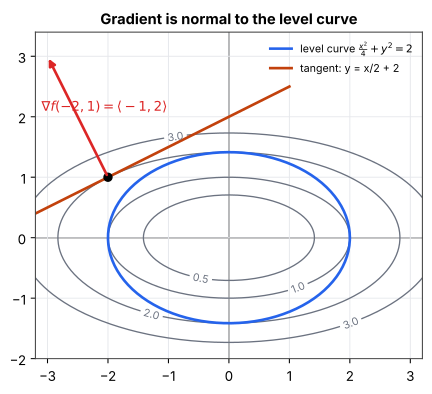
- is normal to level curves (and level surfaces).
Tangent line to a level curve
Tangent to an ellipse
is the level curve of . At : .
Tangent: . The gradient is perpendicular to it.
Tangent plane & normal line to a surface at
- Tangent plane:
- Normal line: , ,
- For at :
Estimating change & linearization
- Change when moving in direction : .
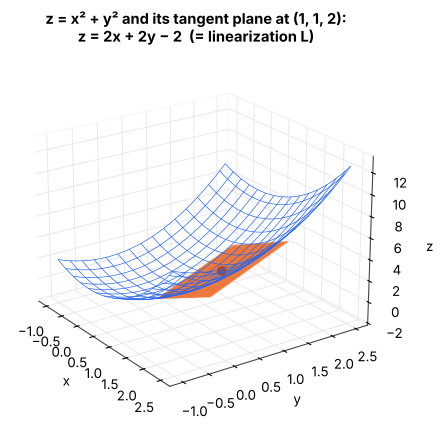
- Linearization at : , and (tangent-plane approximation). Three variables: add .
- Error bound: if on a rectangle around :
Tangent plane = linearization
at : , so . Near the plane and the surface almost coincide.
Part 4 — Extreme Values and Saddle Points
Taylor’s formula (order 2) near
Order :
Local extrema
- Local max at : on an open disk around ; local min: .
- First derivative test: local extremum at an interior point where partials exist ⇒ (horizontal tangent plane).
- Critical point: interior point where , or where or doesn’t exist.
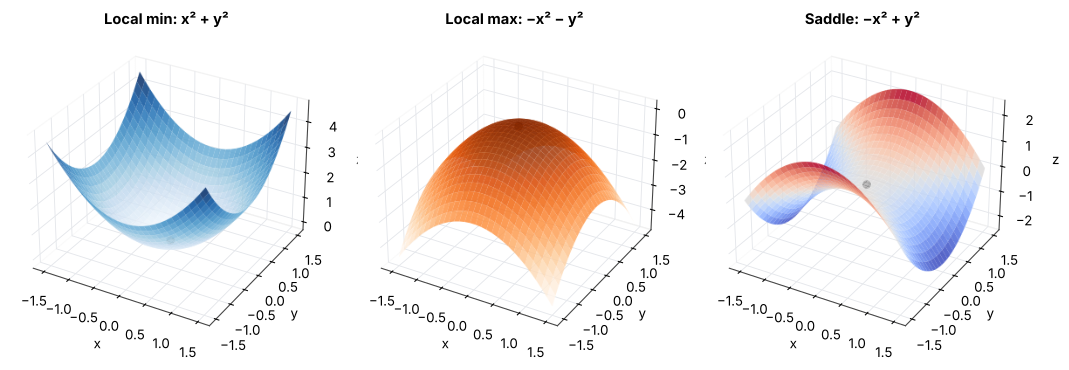
- Saddle point: critical point where every disk around it has points with and points with .
Three kinds of critical point at the origin
: minimum; : maximum; : saddle (up along , down along ). In all three, at .
Second derivative test
With , , and discriminant (Hessian) :
| Condition | Nature |
|---|---|
| , | local maximum |
| , | local minimum |
| saddle point | |
| inconclusive — find another way |
(Comes from completing the square: .)
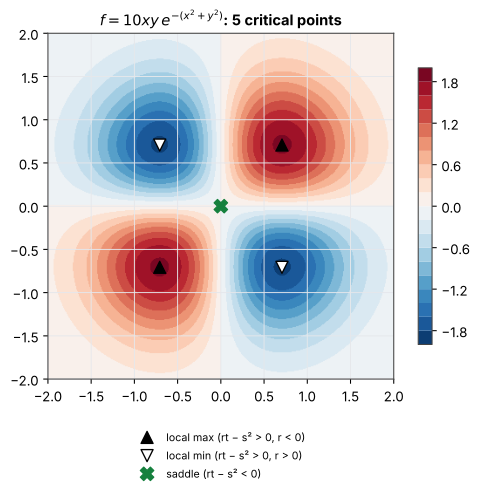
Classifying 5 critical points
: critical points and .
- : , , → saddle.
- Same signs: , → local maxima. Opposite signs: → local minima.
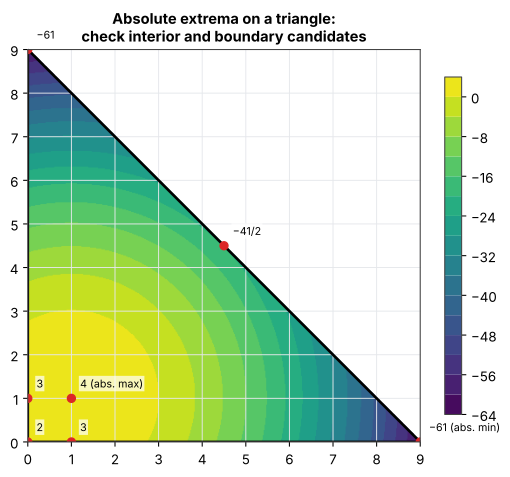
Absolute extrema on a closed, bounded region
- Find interior critical points; evaluate there.
- On each boundary piece, reduce to one variable; find its critical points and the endpoints; evaluate .
- Largest value = absolute max, smallest = absolute min.
Triangle
. Interior: with . Edges: , , , .
Absolute max at ; absolute min at and .
Lagrange multipliers
To optimize subject to a constraint , solve
( = Lagrange multiplier; at the optimum the level curves of and are tangent, so their gradients are parallel.) Tip: to minimize a distance, minimize its square.
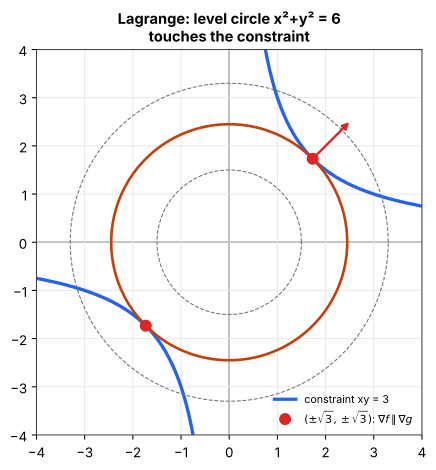
Closest point of to the origin
Minimize with : , ⇒ . gives (impossible), gives .
At those points the level circle is tangent to the hyperbola; distance .