Part A — Infinite series (review)
- Partial sum . converges if exists (real); it diverges if the limit is infinite or doesn’t exist.
- Geometric: iff .
- Divergence test: convergent ⇒ . So ⇒ divergent.
- Ratio test: : converges, diverges, inconclusive.
- Root test: : same conclusions.
- Riemann series: converges iff (harmonic series diverges).
- Alternating series: converges if and is decreasing.
Part B — Power series
- Centered at 0: ; centered at : .
Radius & interval of convergence
If , the series converges absolutely for and diverges for :
(Alternatively, apply the ratio test to the whole term including and solve for .) Always test the endpoints separately (harmonic? alternating?).
Checking the endpoints
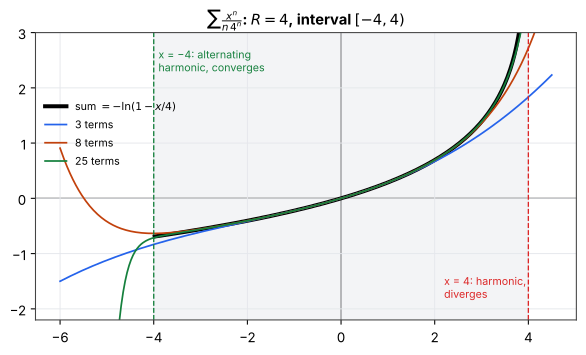
: ⇒ .
: diverges. : converges. Interval ; the sum is .
Differentiation & integration
If with , then on :
- e.g.
- ⇒
Taylor & Maclaurin series
- is analytic on an open interval if it is there (all derivatives exist and are continuous); then it equals its power series on the interval of convergence.
- Taylor series at : . Maclaurin: .
| Function | Series | Valid for |
|---|---|---|
| all | ||
| all | ||
| all | ||
Solving ODEs with power series
Goal: solve with a power series centered at a given .
Classifying
- Regular (ordinary) point: and are defined at .
- Singular point: not regular.
- Regular singular point: singular, but and are defined at .
Which solution form
- regular ⇒ .
- regular singular ⇒ , with to be found (Frobenius method).
- Changing completely changes the solution.
Procedure (regular point, )
- Set , , .
- Substitute into the equation.
- Shift indices so every sum has the same power (e.g. ).
- Start all sums at the same index: pull out the low-order terms separately.
- Set every coefficient to 0 → the first coefficients plus a recurrence relation for .
- Express everything in terms of and :
Series solution
at (regular point): , , and
for .
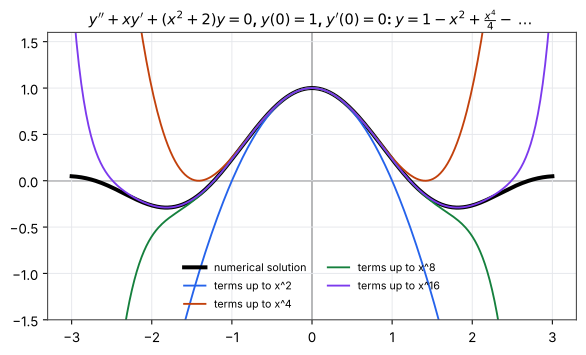
With , : Partial sums match the true solution on a growing interval.