Basics
- Linear because depend on only.
- Homogeneous if , nonhomogeneous otherwise.
- Initial value problem: the equation plus , . Two conditions are needed because solving takes two integrations, and each one introduces a constant.
Homogeneous, constant coefficients:
- If are solutions, so are and .
- are linearly independent if neither is a constant multiple of the other.
- Wronskian: . ⇒ dependent; ⇒ independent.
- General solution: for two independent solutions.
Method: try ⇒ characteristic equation , with .
| Case | Roots | General solution |
|---|---|---|
| real | ||
For an IVP, use the initial conditions to find .
Initial value problem
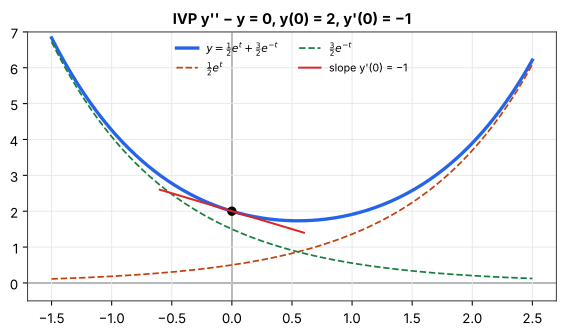
: , (). , ⇒ , .
The three root cases
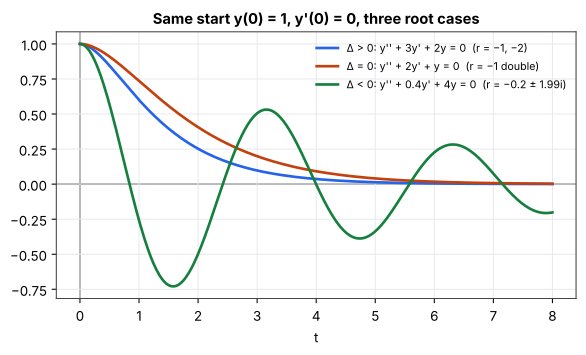
Same start , :
- : pure exponential decay.
- : the fastest decay without oscillating.
- : oscillation inside a decaying envelope .
Nonhomogeneous:
solves the homogeneous equation; is any particular solution of the full equation.
Method of undetermined coefficients
Write in the right form, substitute , and identify the coefficients.
| Trial | ||
|---|---|---|
| Polynomial of degree (with ) | (keep all powers) | — |
| if is not a root; if simple root; if double root | ||
| or | if is not a root; if it is |
Always include both and terms, even if has only one.
Superposition principle: if solves the equation with right side and with , then solves it with . Handle each part of the right side separately.
Resonance (the factor )
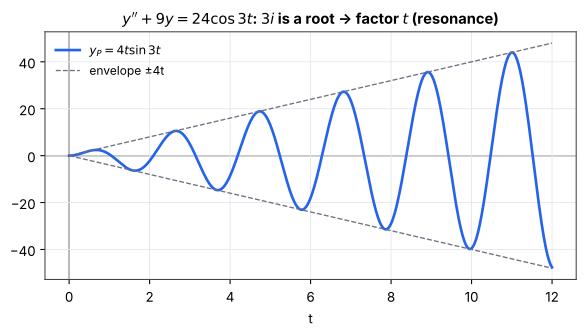
: is a root of ⇒ , try ⇒ , : , an oscillation that grows linearly.
General (variable-coefficient) equations
Standard form: .
Reduction of order (homogeneous)
If is a known solution, a second independent solution is
Then .
Variation of parameters (nonhomogeneous)
With and :
( is the right-hand side in standard form.) General solution: .
Euler–Cauchy equation: ()
Try ⇒ , .
| Case | Solution |
|---|---|
| , roots | |
| , root | |
| , |
Euler–Cauchy equation
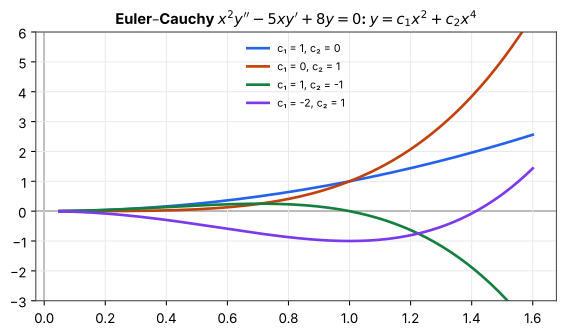
: ⇒ ⇒ .