4.1 Sequences
A sequence is a function from the positive integers to .
- Explicit: given directly in terms of .
- Recursive: given from previous terms () plus initial term(s).
Convergence
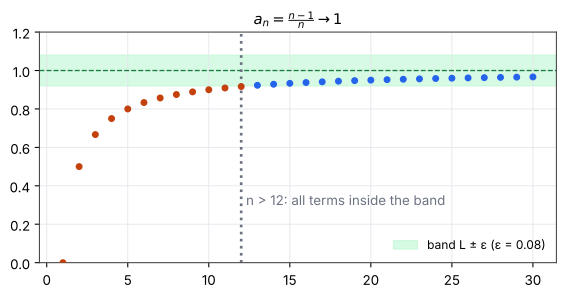
converges to if : .
- finite ⇒ convergent; or limit doesn’t exist ⇒ divergent.
- Limit rules: sum, difference, constant multiple, product, quotient () behave as expected.
- Sandwich theorem: and ⇒ . Consequence: ⇒ .
The ε–N definition
: as soon as , so with we can take .
Commonly occurring limits
Bounded & monotonic
- Bounded above: ; bounded below: ; bounded = both.
- Nondecreasing ; nonincreasing ; monotonic = either.
- Monotonic Sequence Theorem: bounded and monotonic ⇒ convergent (increasing + bounded above, or decreasing + bounded below).
Ways to prove monotonicity
- Sign of ( increasing, decreasing, constant).
- Compare with 1 (positive terms).
- Associate with and study the sign of .
- Induction.
Arithmetic sequences (common difference )
- ,
- Sum: ; number of terms last index first index .
- Always divergent (unless ).
Geometric sequences (ratio )
- , ,
- Sum:
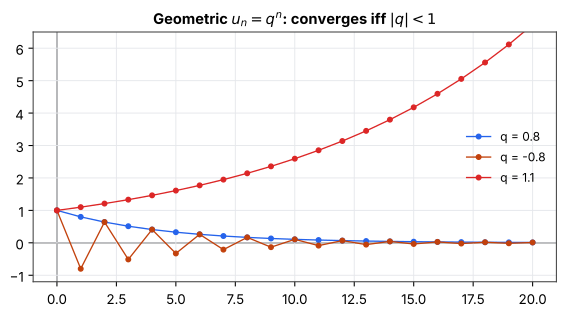
- Converges (to 0) if ; diverges if .
Effect of the ratio
: decreases to 0. : alternates in sign, still . : grows without bound (divergent).
Adjacent sequences
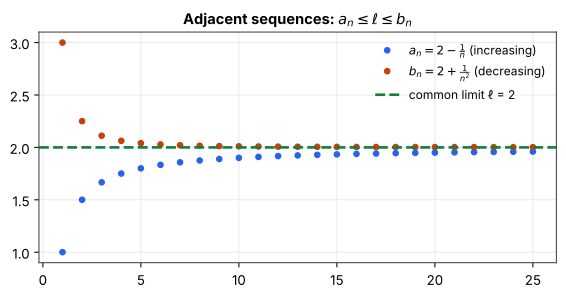
and are adjacent if , increasing, decreasing, and .
⇒ both converge to the same limit , with .
Squeezing a limit
(increasing) and (decreasing), with and ⇒ both converge to .
4.2 Infinite Series
with partial sums . The series converges to if ; otherwise it diverges.
Geometric series
Telescoping series: use partial fractions so terms cancel, e.g. ⇒ .
Convergence tests
- th-term test (divergence): or does not exist ⇒ diverges.
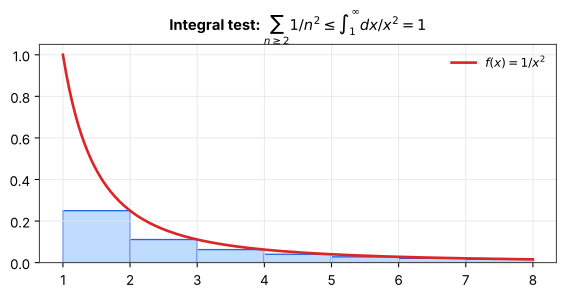
- Integral test: with positive, continuous, decreasing for ⇒ and both converge or both diverge (the integral’s value is not the sum).
- -series (Riemann): converges iff . (: harmonic series, diverges.)
- Direct comparison: : conv ⇒ conv; div ⇒ div.
- Limit comparison: , :
- ⇒ both converge or both diverge;
- and conv ⇒ conv;
- and div ⇒ div.
- Tip: grows slower than for any .
- Absolute convergence: converges ⇒ converges.
- Ratio test: : abs. conv.; (or ) div.; inconclusive. Good with factorials and .
- Root test: : same conclusions as the ratio test. Good with th powers.
- Alternating series (Leibniz): converges if , eventually nonincreasing, and .
- If ⇒ diverges.
- Alternating Riemann series : converges for , diverges for .
- Conditionally convergent: convergent but not absolutely convergent.
Partial sums
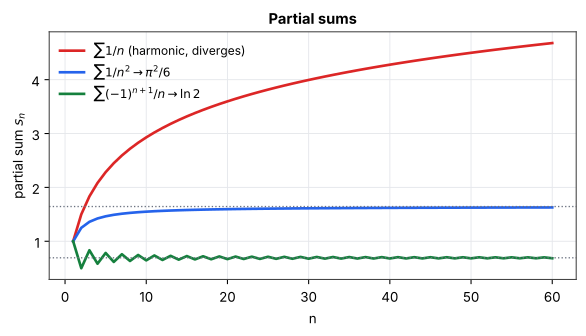
keeps growing (diverges, ), levels off at (), and the alternating oscillates into (Leibniz), although it is only conditionally convergent.
Integral test
The rectangles of height () fit under , so : the series converges.
Strategy summary
- th-term test first.
- Recognize geometric () or -series ().
- Nonnegative terms: integral test, direct or limit comparison, ratio/root.
- Some negative terms: check (absolute ⇒ convergent).
- Alternating: check the Leibniz conditions.