Definitions
An improper integral converges if the limit exists and is finite; otherwise it diverges.
Type I — infinite limits of integration
- for any — both parts must converge.
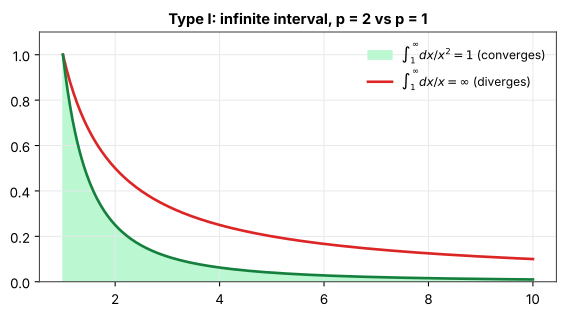
vs
converges, while diverges, even though both integrands go to 0.
Type II — integrand infinite inside (vertical asymptote)
- Discontinuous at :
- Discontinuous at :
- Discontinuous at : — both must converge.
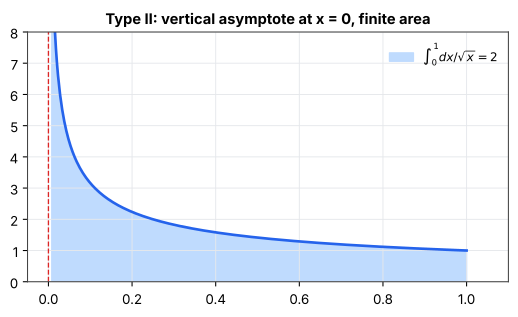
If , a convergent integral is the (finite) area under the curve.
Vertical asymptote with finite area
(here ).
Tests for Convergence
Necessary condition (Type I)
If ⇒ diverges. If the limit is 0, the test is inconclusive.
Riemann (reference) integrals
| Integral | Converges | Diverges |
|---|---|---|
| Type I: | (value ) | |
| Type II: , |
Direct Comparison Test
If for :
- converges ⇒ converges.
- diverges ⇒ diverges.
Also valid for Type II. Handy: () for large .
Limit Comparison (Equivalence) Test
continuous on and
⇒ and both converge or both diverge. In practice: replace by a simpler equivalent (), usually a Riemann integral.
Common equivalences as
| , , , | |
| , | |
| , | , |
At , a polynomial/rational function is equivalent to its leading terms (e.g. ).
Comparison tests
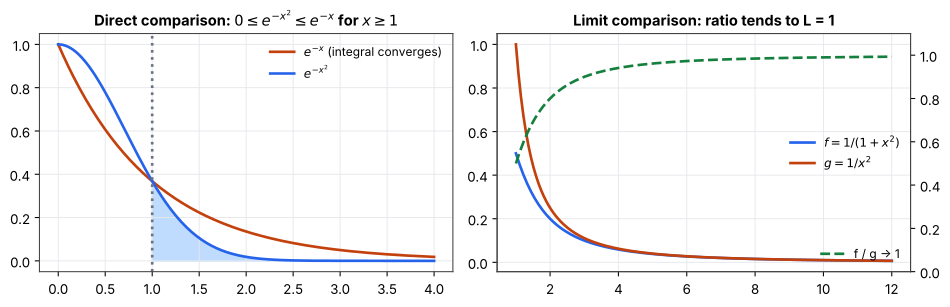
- Direct: on and , so converges (to something below ).
- Limit: , and converges, so converges too (its value is ; the comparison integral’s is 1).
Absolute Convergence
Used when changes sign on the interval.
- is absolutely convergent if converges.
- Absolutely convergent ⇒ convergent, since .
- If diverges, the test is inconclusive.
- Semi-convergent: convergent but not absolutely convergent.
- Typical trick: ⇒ .