course_notes

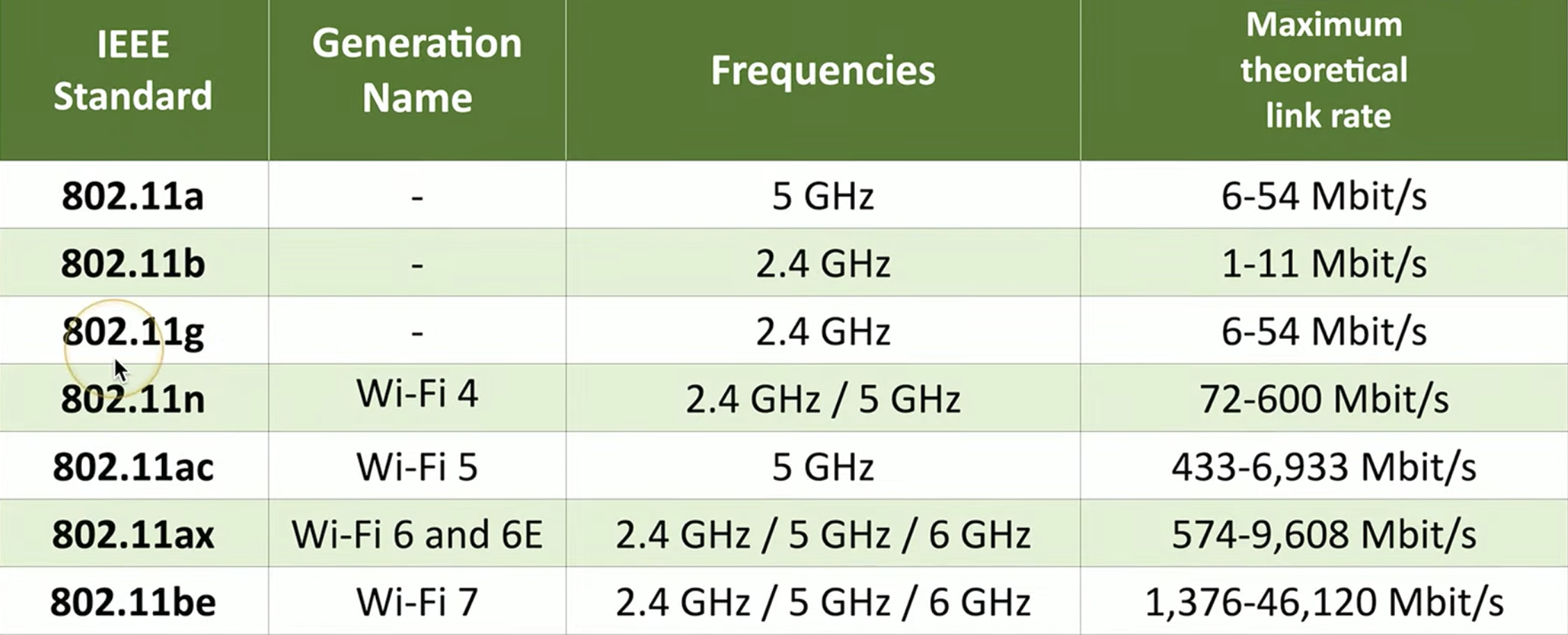
Wireless Networking:

Wi-Fi:

  • Managed by the IEEE LAN/MAN (802)
  • Code: 802.11
  • Wi-Fi alliance handles interoperability testing

4G/LTE:

  • 4G and LTE(long term evolution) are the same
  • Based on GSM and EDGE
  • Support download rate of 150Mb/s
  • LTE-A is an advanced variant of LTE and supports 300Mb/s

5G:

  • 5th generation of cellular networking
  • Higher frequencies
  • Supports speeds of 100Gb/s
  • Better Bandwidth, meaning larger data transfer

Satelite:

  • Higher cost that terrestrial networking
  • 100Mb/s DOWN and 5Mb/s UP
  • Up to 250ms delay
  • Starlink has 40-20ms
  • High frequencies, meaning it really depends on the weather and the environment

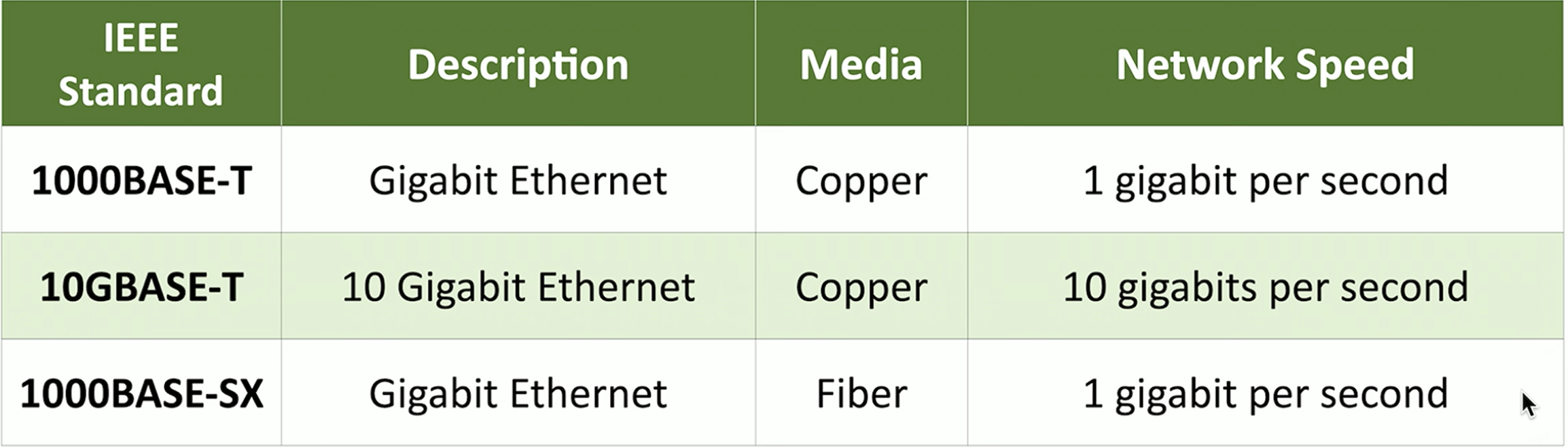
Ethernet Networking:

  • most popular networking technology
  • IEEE 802.3 committee design and document coper and fiber cables
  • Reading the name:
    • number is related to the speed (1000 -> 1000Mb/s | 10G -> 10Gb/s)
    • BASE -> baseband (Uses a single frequency)
    • BROAD -> broadband (Uses many frequency)
    • T -> twisted pair | SX -> short wavelength light | F -> fiber optic

Optical fiber:

  • transmission by light
  • Very difficult to tap / monitor
  • Great for long distance
  • imune to radio interference
    There are two mode of fiber:
  • Multi-mode: Short range(2 km), uses LED, Low frequencies allowing multiple modes
  • Single-mode: Long range(100 km), uses laser beam, smaller core only allowing a single mode

Copper cabling:

Twisted pair copper:

  • the pairs have equal and opposite signals, this is so that if one of the cable goes through interference the other(opposite) will be safe. we then compare the two signals at the end.
  • The speed of the cable is determined by the signal it can support

Coaxial:

  • Rg-6 is a type of coax used for television and high speed internet
Twinaxial:

  • common on 10Gb ethernet cables
  • full duplex
  • five meters
  • low cost
  • low latency compared to coax